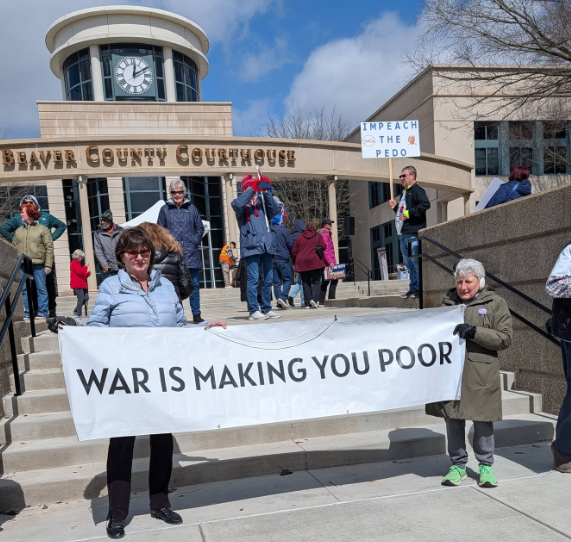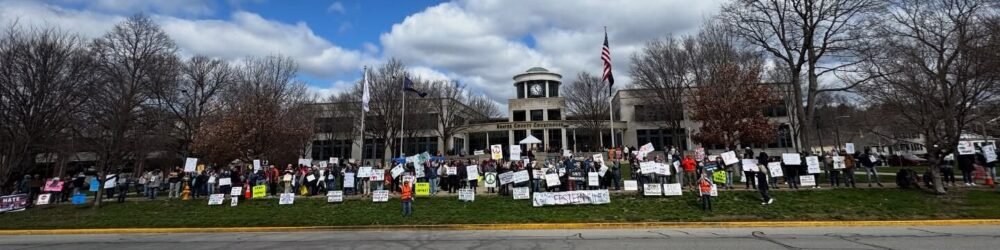
We’re Beaver County Peace Links (BCPL), your neighbors building a safer, better world, while standing up for those who are most at risk under the U.S. imperialist war machine.

  • How 51 Seconds at a Pro-Palestine Protest Could Send a Muslim Student to Prison for 34 years


    Former University of Pittsburgh student Muhammad Ali faces three felonies for a brief tug-of-war with an officer over a metal barrier.
    By Mehr Sher
    Dropsite News, Apr 13, 2026

    On June 3, 2024, the 21-year-old University of Pittsburgh senior was protesting in support of a pro-Palestine encampment in the center of campus. University police had set up metal barriers, held together with zip ties, to keep protesters from delivering food, water, and supplies to the encampment. Frustrated, some protesters tried to move the barriers.
    Ali bent down to pick up a fallen barrier. An officer grabbed the other side and tried to pull it from his hands. After a brief exchange of words, Ali let go and stepped back, his hands raised. He thought that was the end of it. Weeks later, Ali was charged with multiple crimes, including three felonies. The most serious charges against him carry a maximum sentence of 34 years in prison.
    Ali’s attorney and supporters say he is being treated harshly because he is Muslim and brown. They point out that the Allegheny County District Attorney’s office filed criminal charges against other protesters, but nearly all of them were offered plea deals with lesser charges, or a pretrial rehabilitation program that if completed would leave them with no criminal record.
    But Ali and another community member, his co-defendant Cole Florkewicz, who is white, were not offered any deal. Both are still facing felony charges.
    Assistant District Attorney James Sheets said in court that the decision to prosecute Ali “was not based on where in the world he comes from, the color of his skin or whatever God to whom he prays,” and that he is not “being made an example of.”
    The Allegheny County District Attorney’s office and the University of Pittsburgh Police Department did not respond to requests for comment. The University of Pittsburgh did not respond to questions about Ali’s case.
    The ACLU of Pennsylvania and other advocacy groups have raised concerns about racial disparities in Allegheny County’s criminal justice system since 2021 and called for accountability in prosecutorial practices.
    “I think there’s a very concerted effort, and there has been for decades, to demonize speech about Palestine and speech that is against Israel,” said Solomon Worlds, a staff attorney with the ACLU of Pennsylvania, “speech about Palestine being the exception to free speech.” These colleges and universities, he said, seem to be targeting pro-Palestine activists and speech “as a way to show the federal government that they’re tough on antisemitism, so that they don’t lose funding.”
    For Ali, who had no prior criminal record, the possibility of a felony conviction for exercising his First Amendment rights is shocking. “This cannot be real,” he said. “Why am I being charged with felonies?”
    The Crackdown on Pro-Palestinian Protest
    After the Oct. 7 attacks by Hamas and the launch of Israel’s war in Gaza, protests erupted at more than 525 U.S. campuses, leading to thousands of arrests, doxxing campaigns, and criminal charges against demonstrators. The University of Pittsburgh in particular took a number of harsh actions against students and faculty involved in pro-Palestinian speech and protests.
    In December 2024, Students for Justice in Palestine held an overnight “study-in” in the library. Students who participated wore keffiyehs, traditional scarves that symbolize Palestinian identity, and Palestinian flags as they prepared for their finals. The university held a conduct hearing against the student organization and suspended them in March 2025, after an open letter was released condemning this action.
    The ACLU of Pennsylvania sued Pitt on behalf of the students. A federal judge ruled last August that the group’s suspension was a violation of protected speech and ordered Pitt to reinstate them.
    That month, Elon Dancy II, a Pitt professor in the School of Education, filed a federal lawsuit against the university and one of its deans claiming he was removed from leadership positions after he defended a group of students who criticized the dean’s response to the war in Gaza.
    In April 2024, Ali, who had started at Pitt in 2021 and founded an organization called Progressive Students for Change, helped organize the first encampment at the University of Pittsburgh. The encampment lasted about a week and ended peacefully. In June of that year, as the war in Gaza entered its eighth month, students and community members set up a second encampment at Pitt, calling for transparency on endowment investments and divestment from Israel.
    Colorful tents dotted the grass outside the Cathedral of Learning, the Gothic skyscraper at the center of campus. Protesters, including Ali, arrived to support those inside, chanting and holding up signs. Ali wasn’t one of the leaders or organizers for this effort, but showing up and supporting the people in the encampment was important to him, he said.
    Campus police arrived soon after, setting up metal barriers to put distance between the encampment and their supporters. The next morning, when protesters returned, they saw that Pitt Police had moved the metal barriers farther out from the encampment. The distance set the tone. By late afternoon, the mood among protesters had shifted. Ali could sense the tension in the air. Frustration rippled through the crowd.
    On the second day, protesters tried to pull apart the zip-tied barriers to move supplies inside. Campus police and protesters struggled over the fence pieces. Ali could see some protesters were injured from the encounters. Soon, only a few of the barriers remained standing. Those who tried to move through the gaps were met with force.
    The charges against Ali stem from a 51-second confrontation recorded on body-camera footage obtained by Drop Site.
    Footage from University of Pittsburgh Police Lt. Brooke Riley’s body camera shows a 51-second confrontation during a pro-Palestine protest that led to charges against Muhammad Ali, on June 3, 2024.
    Lt. Brooke Riley’s body camera was recording as she repeatedly screamed at other protesters and Ali, demanding to know whether they wanted to hurt her. Ali, wearing a tee shirt with beige shorts and a white face mask, walked over. He checked on another protestor and stepped between them and Riley, standing near fallen barriers. He stared ahead and said “yes.” After Ali tried to pick up one of the barriers, Riley, Ali, and Florkewicz pulled back and forth on the metal fence for a few seconds before Ali let go and stepped back.
    “It was an emotional response that what she was saying is incorrect, but looking back it feels like an entrapment thing with regards to the questions she was asking about remembering her and also whether or not I wanted to hurt her,” Ali said.
    “I think those things are connected in a way,” he said.
    A Pitt police criminal complaint alleges that this brief tug-of-war over the barrier by Riley, Ali, and Florkewicz, caused “numbness and pain” in Riley’s fingers and bruising to her leg.
    Riley did not respond to requests for comment.

    Exploring the Intersection of Peace and Justice

    • Exploring the Intersection of Peace and Justice

      The Importance of Peace and Justice in Society Peace and justice are fundamental pillars that sustain healthy societies. They are interwoven concepts that can lead to harmony and stability. Without peace, there can be no justice; without justice, peace is merely an illusion. Communities thrive when these principles are upheld, fostering environments where individuals feel…

    • Hello world!

      Welcome to WordPress. This is your first post. Edit or delete it, then start writing!

  • How 51 Seconds at a Pro-Palestine Protest Could Send a Muslim Student to Prison for 34 years


    Former University of Pittsburgh student Muhammad Ali faces three felonies for a brief tug-of-war with an officer over a metal barrier.
    By Mehr Sher
    Dropsite News, Apr 13, 2026

    On June 3, 2024, the 21-year-old University of Pittsburgh senior was protesting in support of a pro-Palestine encampment in the center of campus. University police had set up metal barriers, held together with zip ties, to keep protesters from delivering food, water, and supplies to the encampment. Frustrated, some protesters tried to move the barriers.
    Ali bent down to pick up a fallen barrier. An officer grabbed the other side and tried to pull it from his hands. After a brief exchange of words, Ali let go and stepped back, his hands raised. He thought that was the end of it. Weeks later, Ali was charged with multiple crimes, including three felonies. The most serious charges against him carry a maximum sentence of 34 years in prison.
    Ali’s attorney and supporters say he is being treated harshly because he is Muslim and brown. They point out that the Allegheny County District Attorney’s office filed criminal charges against other protesters, but nearly all of them were offered plea deals with lesser charges, or a pretrial rehabilitation program that if completed would leave them with no criminal record.
    But Ali and another community member, his co-defendant Cole Florkewicz, who is white, were not offered any deal. Both are still facing felony charges.
    Assistant District Attorney James Sheets said in court that the decision to prosecute Ali “was not based on where in the world he comes from, the color of his skin or whatever God to whom he prays,” and that he is not “being made an example of.”
    The Allegheny County District Attorney’s office and the University of Pittsburgh Police Department did not respond to requests for comment. The University of Pittsburgh did not respond to questions about Ali’s case.
    The ACLU of Pennsylvania and other advocacy groups have raised concerns about racial disparities in Allegheny County’s criminal justice system since 2021 and called for accountability in prosecutorial practices.
    “I think there’s a very concerted effort, and there has been for decades, to demonize speech about Palestine and speech that is against Israel,” said Solomon Worlds, a staff attorney with the ACLU of Pennsylvania, “speech about Palestine being the exception to free speech.” These colleges and universities, he said, seem to be targeting pro-Palestine activists and speech “as a way to show the federal government that they’re tough on antisemitism, so that they don’t lose funding.”
    For Ali, who had no prior criminal record, the possibility of a felony conviction for exercising his First Amendment rights is shocking. “This cannot be real,” he said. “Why am I being charged with felonies?”
    The Crackdown on Pro-Palestinian Protest
    After the Oct. 7 attacks by Hamas and the launch of Israel’s war in Gaza, protests erupted at more than 525 U.S. campuses, leading to thousands of arrests, doxxing campaigns, and criminal charges against demonstrators. The University of Pittsburgh in particular took a number of harsh actions against students and faculty involved in pro-Palestinian speech and protests.
    In December 2024, Students for Justice in Palestine held an overnight “study-in” in the library. Students who participated wore keffiyehs, traditional scarves that symbolize Palestinian identity, and Palestinian flags as they prepared for their finals. The university held a conduct hearing against the student organization and suspended them in March 2025, after an open letter was released condemning this action.
    The ACLU of Pennsylvania sued Pitt on behalf of the students. A federal judge ruled last August that the group’s suspension was a violation of protected speech and ordered Pitt to reinstate them.
    That month, Elon Dancy II, a Pitt professor in the School of Education, filed a federal lawsuit against the university and one of its deans claiming he was removed from leadership positions after he defended a group of students who criticized the dean’s response to the war in Gaza.
    In April 2024, Ali, who had started at Pitt in 2021 and founded an organization called Progressive Students for Change, helped organize the first encampment at the University of Pittsburgh. The encampment lasted about a week and ended peacefully. In June of that year, as the war in Gaza entered its eighth month, students and community members set up a second encampment at Pitt, calling for transparency on endowment investments and divestment from Israel.
    Colorful tents dotted the grass outside the Cathedral of Learning, the Gothic skyscraper at the center of campus. Protesters, including Ali, arrived to support those inside, chanting and holding up signs. Ali wasn’t one of the leaders or organizers for this effort, but showing up and supporting the people in the encampment was important to him, he said.
    Campus police arrived soon after, setting up metal barriers to put distance between the encampment and their supporters. The next morning, when protesters returned, they saw that Pitt Police had moved the metal barriers farther out from the encampment. The distance set the tone. By late afternoon, the mood among protesters had shifted. Ali could sense the tension in the air. Frustration rippled through the crowd.
    On the second day, protesters tried to pull apart the zip-tied barriers to move supplies inside. Campus police and protesters struggled over the fence pieces. Ali could see some protesters were injured from the encounters. Soon, only a few of the barriers remained standing. Those who tried to move through the gaps were met with force.
    The charges against Ali stem from a 51-second confrontation recorded on body-camera footage obtained by Drop Site.
    Footage from University of Pittsburgh Police Lt. Brooke Riley’s body camera shows a 51-second confrontation during a pro-Palestine protest that led to charges against Muhammad Ali, on June 3, 2024.
    Lt. Brooke Riley’s body camera was recording as she repeatedly screamed at other protesters and Ali, demanding to know whether they wanted to hurt her. Ali, wearing a tee shirt with beige shorts and a white face mask, walked over. He checked on another protestor and stepped between them and Riley, standing near fallen barriers. He stared ahead and said “yes.” After Ali tried to pick up one of the barriers, Riley, Ali, and Florkewicz pulled back and forth on the metal fence for a few seconds before Ali let go and stepped back.
    “It was an emotional response that what she was saying is incorrect, but looking back it feels like an entrapment thing with regards to the questions she was asking about remembering her and also whether or not I wanted to hurt her,” Ali said.
    “I think those things are connected in a way,” he said.
    A Pitt police criminal complaint alleges that this brief tug-of-war over the barrier by Riley, Ali, and Florkewicz, caused “numbness and pain” in Riley’s fingers and bruising to her leg.
    Riley did not respond to requests for comment.

    Hello world!

    • Exploring the Intersection of Peace and Justice

      The Importance of Peace and Justice in Society Peace and justice are fundamental pillars that sustain healthy societies. They are interwoven concepts that can lead to harmony and stability. Without peace, there can be no justice; without justice, peace is merely an illusion. Communities thrive when these principles are upheld, fostering environments where individuals feel…

    • Hello world!

      Welcome to WordPress. This is your first post. Edit or delete it, then start writing!

WHAT WE DO

  1. Peace vigil: Most Saturdays from 1 to 2 p.m. in front of the Beaver County Courthouse (map) and other rotating locations. Signs provided or bring your own.
  2. Info sharing: We’ve organized documentary screenings, hosted speakers, and brought perspectives to Beaver County to educate and empower the people.
  3. Mobilizing for our community: We call our representatives, campaign for local progressive officials, and support organizations working for a more peaceful world.

We’ve been here in Beaver County working for peace for over 40 years.
Trying to build a safer better world, through both domestic and foreign policy.


We know the two are connected.

We know we need it, and you do too, and everyone in our community.

War: we can’t afford it.
Peace: we can’t live without it
.

ABOUT US

BCPL was formed as an anti-war citizens group in 1982. We’ve been campaigning for peace and justice in Western Pennsylvania through local organizing, protests and peace vigils, and political action. Our aim is to inform Beaver County citizens about the cost of war in life, liberty and the pursuit of happiness, and how we can best invest in our future.

Groups we’re connected to:

CONNECT WITH US

Mailing address:
BCPL
PO Box 31
Ambridge PA 15003

Proudly powered by WordPress